
Fire-Water Pillow Tanks
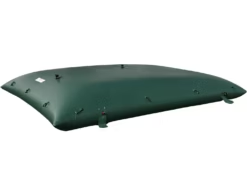
Static fire-water pillow tanks from 30 to 240 m³, manufactured in France. Lightweight, self-supporting and installed in hours with no groundworks, they replace a concrete or buried reserve at 50 to 70 % lower capital cost. Supplied with couplings and a 5-year manufacturer's warranty.
-

Pillow tank 120 m³ 120,000 litres – static fire-water reserve
Original price was: 4 925,00€.4 524,00€Current price is: 4 524,00€. HT -
Pillow tank 100 m³ 100,000 litres – static fire-water reserve
Original price was: 3 828,00€.3 628,00€Current price is: 3 628,00€. HT -
Pillow tank 200 m³ 200,000 litres – static fire-water reserve
7 671,00€ HT -
Pillow tank 60 m³ 60,000 litres – static fire-water reserve
Original price was: 2 357,00€.2 239,00€Current price is: 2 239,00€. HT -
Pillow tank 30 m³ 30,000 litres – static fire-water reserve
Original price was: 1 345,00€.1 213,00€Current price is: 1 213,00€. HT
Lire le guide complet
A fire-water tank is only valid if it satisfies the local requirement
Volume is not a commercial choice — it is set by the requirement applying to the site, and it must be agreed before anything is ordered. In the United Kingdom the framework depends on what is being protected:
- BS 9990 — non-automatic fire-fighting systems in buildings, including static water supplies and their access arrangements.
- LPC Rules and BS EN 12845 — where the reserve feeds an automatic sprinkler installation.
- Approved Document B of the Building Regulations — access and water supplies for the fire service, applied in practice through Building Control.
- The local Fire and Rescue Service remains the deciding authority on siting, required volume, access for appliances and the type of coupling.
Equivalent rules apply in Scotland, Wales and Northern Ireland. Confirm the requirement with the authority before sizing: that figure, not an estimate, determines the tank.
Capacities most often specified
Low-profile models (1.00–1.30 m high) for efficient appliance suction. Bespoke formats available on request.
| Capacity | Litres | Dimensions (L × W) | Typical use | Indicative price excl. VAT * |
|---|---|---|---|---|
| 30 m³ | 30,000 L | 6.80 × 4.40 m | Minimum reserve, isolated dwellings | From €2,600 |
| 60 m³ | 60,000 L | 9.20 × 6.00 m | Housing scheme, farm, small business | From €4,500 |
| 120 m³ | 120,000 L | 12.00 × 8.00 m | Public building, industrial unit, warehouse | From €7,500 |
| 240 m³ and above | 240,000 L | Bespoke | Regulated site, large logistics warehouse | Free quotation |
* Indicative prices excluding VAT, excluding accessories and installation. Ask for a quotation against your own requirement.
Why a pillow tank rather than a concrete reserve
- French manufacture — high-tenacity PVC-coated reinforced polyester fabric, designed and assembled in our own workshop. Full technical documentation supplied for your submission.
- No civil engineering — a level, stabilised area and a geotextile mat are enough. Commissioned in a day, against several weeks for a concrete reserve.
- Support through approval — help with sizing against the authority’s requirement, choice of suction arrangement, and the documentation your assessor will ask for.
- Water kept ready — the closed opaque membrane keeps the water shielded from light, frost and contamination, available all year.
Frequently asked questions
What volume should I plan for?
The figure comes from the authority assessing your site, not from a catalogue. It depends on the building type, its use and the risk being protected. Send us the requirement you have been given and we will confirm the model and the footprint.
Does the tank need a concrete base?
No. A level, compacted area cleared of stones and sharp objects, with a geotextile mat, is enough. That is the main reason a pillow tank installs in hours rather than weeks.
Will the water freeze in winter?
The membrane is closed and opaque, which limits surface icing. In prolonged frost, the suction arrangement and any exposed fittings are the parts to protect — we specify them with the site conditions in mind.
What maintenance does it need?
An annual visual inspection of the membrane, the couplings and the suction point, plus whatever periodic check the authority requires. There is no filtration or moving part to service.