
Pillow Tanks from 1 to 500 m³ – Prices and Quotes
Flocea manufactures pillow tanks — also known as bladder tanks or flexible water tanks — from 1 to 500 m³ for rainwater harvesting, potable water, irrigation, slurry, liquid fertiliser and static fire-water storage. Compare capacities, applications and fittings before choosing a model or requesting a bespoke build.
-

Pillow tank 60 m³ 60,000 litres – static fire-water reserve
Original price was: 2 357,00€.2 239,00€Current price is: 2 239,00€. HT -

Pillow tank 25 m³ 25,000 litres – agricultural water storage and irrigation
Original price was: 1 119,00€.979,00€Current price is: 979,00€. HT -
Pillow tank 8 m³ 8,000 litres – temporary or permanent potable water storage
Original price was: 542,00€.469,00€Current price is: 469,00€. HT -
Pillow tank 5 m³ 5,000 litres – temporary or permanent potable water storage
Original price was: 468,00€.399,00€Current price is: 399,00€. HT -
Pillow tank 30 m³ 30,000 litres – static fire-water reserve
Original price was: 1 345,00€.1 213,00€Current price is: 1 213,00€. HT -
Pillow tank 20 m³ 20,000 litres – agricultural water storage and irrigation
Original price was: 897,00€.785,00€Current price is: 785,00€. HT -
Pillow tank 7 m³ 7,000 litres – temporary or permanent potable water storage
Original price was: 499,00€.437,00€Current price is: 437,00€. HT -
Crawl Space Pillow Tanks, Pillow Tanks from 1 to 500 m³ – Prices and Quotes, Rainwater Harvesting Pillow Tanks
Pillow tank 6 m³ 6,000 litres – rainwater harvesting and storage
Original price was: 468,00€.399,00€Current price is: 399,00€. HT -
Pillow tank 120 m³ 120,000 litres – static fire-water reserve
Original price was: 4 925,00€.4 524,00€Current price is: 4 524,00€. HT -
Pillow tank 15 m³ 15,000 litres – agricultural water storage and irrigation
Original price was: 753,00€.679,00€Current price is: 679,00€. HT -
Pillow tank 6 m³ 6,000 litres – temporary or permanent potable water storage
Original price was: 468,00€.399,00€Current price is: 399,00€. HT -
Crawl Space Pillow Tanks, Pillow Tanks from 1 to 500 m³ – Prices and Quotes, Rainwater Harvesting Pillow Tanks
Pillow tank 10 m³ 10,000 litres – rainwater harvesting and storage
Original price was: 630,00€.550,00€Current price is: 550,00€. HT


Lire le guide complet
Which pillow tank suits your application?
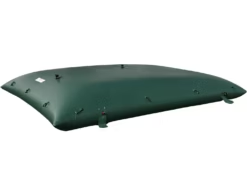
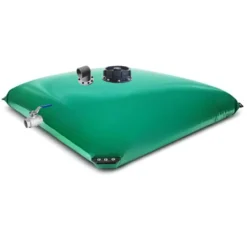
A pillow tank is a closed reservoir made from a welded technical membrane that forms a sealed envelope. It fills progressively and takes its shape from the volume of liquid it holds. This gives you storage capacity without installing a rigid tank and, on most sites, without groundworks or a concrete base.
Capacity in litres is only part of the decision. Start by identifying the liquid, the autonomy you need, the space available and the equipment that will be connected to the tank. The main Flocea ranges answer different constraints:
- rainwater harvesting: garden, washdown, permitted domestic uses or buffer storage, with suitable filtration and overflow;
- potable water storage: membrane, fittings and commissioning procedure matched to drinking-water use;
- agriculture and irrigation: irrigation autonomy, livestock watering or farm reserve sized to seasonal demand;
- static fire-water storage: usable volume, access and suction arrangement agreed with the local Fire and Rescue Service;
- installation in a crawl space or void: low profile, access to the void and bearing area to be checked before ordering;
- bespoke manufacture: dimensions, position of connections and nature of the liquid defined from the actual site.
Capacities from 1 to 500 m³: think in usable volume
Most enquiries start with a 5 m³, 10 m³, 20 m³, 30 m³, 50 m³ or 100 m³ pillow tank. These are nominal capacities. The right volume is calculated from the consumption or flow rate you need to cover, how often the tank is refilled, and the margin of autonomy you want to keep.
| Indicative capacity | Typical applications | Points to check |
|---|---|---|
| 1 to 5 m³ | Garden, small reserve, temporary storage | Space available, access and refill frequency |
| 6 to 15 m³ | Rainwater harvesting, dwellings, buffer storage | Roof area, filtration, pump and overflow |
| 20 to 50 m³ | Irrigation, agriculture, slurry, construction sites | Autonomy, draw-off rate and siting |
| 60 to 240 m³ | Static fire-water supply, farms or local authorities | Required volume, suction point and appliance access |
| 250 to 500 m³ | Large agricultural or industrial storage | Dimensions, ground survey and connections |
For rainwater harvesting, roof area and local rainfall determine how much water you can realistically collect. For irrigation, work from daily demand and the number of days of autonomy required. For a fire-water project, the volume is set by the requirements applying to the site — it should never be chosen on a commercial estimate alone.
Potable and non-potable: a distinction to settle first
Potable and non-potable storage are not interchangeable. A tank intended for drinking water requires a membrane and fittings suitable for contact with water intended for human consumption, together with a defined cleaning and commissioning procedure. The reference framework is European: Directive (EU) 2020/2184 sets, in its Article 11, the minimum hygiene requirements for materials in contact with drinking water — the scheme that progressively replaces the former national approvals.
Non-potable duties — rainwater harvesting, irrigation, washdown, slurry, fire-water — are far less constrained, which is why the same nominal volume can carry a very different specification and price. Tell us the intended use at enquiry stage and we will confirm which membrane applies before you order.
Static fire-water storage: what to confirm
A fire-water pillow tank is more than a bag of water. The project covers the reserve itself, the connections, the suction arrangement, access and signage. In the United Kingdom, the applicable framework depends on the site: BS 9990 covers non-automatic fire-fighting systems in buildings, sprinkler reserves fall under the LPC Rules and BS EN 12845, and the local Fire and Rescue Service remains the deciding authority on siting, access and the required volume.
Before quoting, confirm the required volume, the distance between the reserve and the draw-off point, the coupling type, protection against impact or frost, and access conditions for appliances.
Installation, connections and accessories
The tank must sit on a level, stable, clean platform sized for its full footprint. Stones, sharp objects, roots and changes in level must be removed. A ground protection mat may be advisable depending on the terrain. Keep the tank accessible so that fittings can be inspected and maintenance carried out.
Filling, draining, overflow and draw-off are configured to suit the project. Valve diameter directly governs the flow rate available. The pump is then selected from the expected flow rate, the total head and the friction losses in the system.
Pillow tank prices and requesting a quotation
Price varies with capacity, membrane, stored liquid, dimensions, connections and options. Two tanks of identical volume can carry very different specifications if one is destined for drinking water and the other for farm slurry or a fire-water reserve. Standard models can be ordered outright once the requirement is clearly defined. A short technical review is preferable as soon as the application, the site or the connections fall outside a routine configuration.
To get a useful proposal, tell us the liquid, the volume, the location, the space available, the connection sizes and your required lead time. Bespoke products are shown as “price on application” where the price depends on the final configuration.
Frequently asked questions about pillow tanks
What capacity should I choose for rainwater harvesting?
The calculation depends on roof area, local rainfall, intended uses and the autonomy you want. A 5 to 15 m³ reserve covers a great many domestic projects, while agricultural or community requirements can run to several tens of cubic metres.
Can a pillow tank store drinking water?
Yes, provided the membrane, the fittings and the commissioning procedure are suitable for contact with water intended for human consumption, in line with the minimum hygiene requirements of Directive (EU) 2020/2184. Confirm this specification before ordering — a non-potable tank cannot simply be repurposed.
Can a pillow tank be left outdoors all year round?
Yes, provided the ground preparation, the site conditions and the operating limits of the chosen model are respected. Fittings must remain accessible and protected against frost.
Do I need a pump with the tank?
A pump is required whenever the water has to be delivered at a given flow rate or pressure. It is sized from the head, the pipe run, the friction losses and the end use.