
Solar Water Pumps
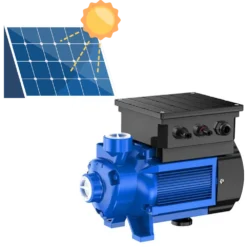
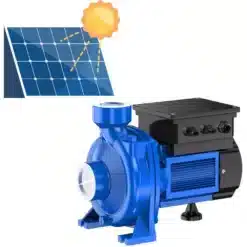
Solar water pumps from 24 V to 96 V, delivering up to 25,000 L/h, supplied with matched PV panels. They pump entirely off-grid: boreholes, irrigation, livestock watering, pool or pillow-tank filling. Manufactured and tested in France.
-

Solar water pump 48 V – 3,300 L/h
Original price was: 359,00€.329,00€Current price is: 329,00€. HT -
Solar water pump 24 V – 2,800 L/h
Original price was: 289,00€.269,00€Current price is: 269,00€. HT -
Solar water pump 36 V – solar booster set 3,000 L/h
299,00€ HT -
Solar water pump 48 V – 5,000 L/h, 30 m head
349,00€ HT -
Solar surface pump set 72 V – 25,000 L/h, 18 m head
Original price was: 491,00€.459,00€Current price is: 459,00€. HT -
High-output solar water pump 96 V – 25,000 L/h
Original price was: 554,00€.499,00€Current price is: 499,00€. HT -
Solar centrifugal water pump 48 V – 15,000 L/h
399,00€ HT -
Solar water pump 72 V – 3,300 L/h
Original price was: 439,00€.399,00€Current price is: 399,00€. HT
Lire le guide complet
- 8 models — 24 V to 96 V
- 25,000 L/h — maximum flow
- No electricity bill — no supply, no standing charge
- Panels included — sized for each model
Which model? Range comparison
Every application has its own flow and head requirement. This table narrows the choice.
| Model | Voltage | Max flow | Main use | Price excl. VAT |
|---|---|---|---|---|
| Solar pump 24 V | 24 V | 2,800 L/h | Garden, shallow well, domestic use | €269 |
| Solar pump 36 V | 36 V | 3,000 L/h | Booster set, light irrigation, well | €299 |
| Centrifugal 48 V | 48 V | 5,000 L/h | Surface irrigation, swimming pool | €349 |
| Centrifugal 72 V | 72 V | 25,000 L/h | Large-area irrigation, livestock | €459 |
| Centrifugal 96 V | 96 V | 25,000 L/h | Intensive farming, remote sites | €499 |
All models ship with PV panels. Flow figures are indicative and depend on available sunlight. Ask for sizing on your own figures.
Applications
- 🌊 Boreholes and wells: solar centrifugal pumps handle deep abstraction, reaching up to 100 m of head depending on model. Well suited to supplying an off-grid property or watering stock. Pair one with a pillow tank to build a self-sufficient reserve.
- 🏊 Swimming pools: sized for pool filtration, they remove the electricity cost of the filter cycle altogether. The system follows available sunlight. Plug-and-play installation, stainless components, quiet running.
- 🌱 Irrigation: automatic priming makes daily use straightforward, from a private plot to a working farm. The 48 V model covers areas of several hectares. Combine it with an agricultural pillow tank to irrigate at night or under cloud.
- 🚜 Agriculture: the 72 V and 96 V models (25,000 L/h) are built for demanding holdings — watering large herds, filling tanks, abstracting from a spring or reservoir. Long-life brushless motor, corrosion-resistant stainless components.
Solar or mains pump: how to decide
The comparison is economic rather than ideological, and it turns on the site.
- Solar wins where there is no mains supply, where bringing one in would cost more than the pump itself, or where pumping is mainly daytime and seasonal — precisely the irrigation profile.
- Mains still makes sense where a supply already exists and you need flow on demand at night or in poor weather, without batteries.
- The deciding point: a solar pump has no consumption and no standing charge, but its output follows the sun. Paired with a tank, that limitation disappears — pump by day, draw when you need it.
Frequently asked questions
How does a solar water pump work?
PV panels convert sunlight into direct current that feeds the pump motor directly. Our models include an MPPT controller that optimises output against available sunlight. The pump runs whenever there is sun, with no battery required for daytime duties.
Which solar pump for my borehole?
Two figures decide it: the depth of the borehole (head) and the flow you need. For a borehole under 30 m with domestic demand, the 36 V model (3,000 L/h) is usually enough. For deeper abstraction or agricultural demand, the 72 V or 96 V models are the sensible choice.
Are the solar panels included?
Yes. Every pump ships with PV panels sized to its power requirement, from 50 W to 1,500 W depending on the model. There is no separate hunt for a compatible panel.
Can the pumped water be stored in a pillow tank?
Yes — and it is the most cost-effective route to water self-sufficiency. The pump fills the tank during the day; the reserve then covers irrigation or stock watering at night or under cloud. See the pillow tank range.