
Rigid Inflatable Pools
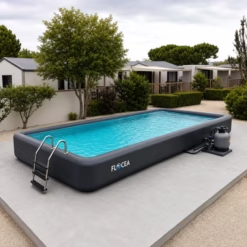
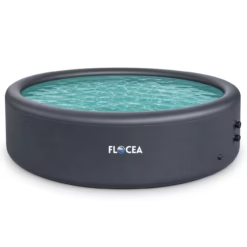
Rigid inflatable pool: a stable pool without a metal frame. High-pressure Drop-Stitch walls combining rigidity, seasonal installation and compact storage — a pool built for adults and families, not a garden toy.

Lire le guide complet
Why choose a rigid inflatable pool
It sits between the conventional inflatable pool and the framed above-ground pool. Inflated to high pressure, the walls become firm and hold their shape without metal legs around the perimeter.
- High-pressure walls: Drop-Stitch construction limits wall deflection as pressure and water level rise.
- No visible frame: the ground footprint stays close to the pool itself, with no tubular structure projecting around it.
- Seasonal installation: the pool is set up and taken down according to the model’s instructions and the ground conditions.
- Compact storage: emptied, cleaned, dried and deflated, it takes far less room than a traditional rigid pool.
What Drop-Stitch construction is
A Drop-Stitch pool uses two reinforced skins joined by a great many internal threads. On inflation, those threads hold the surfaces a constant distance apart, producing a flat, very firm wall. Working pressure, reinforcement, material thickness and assembly method vary between models.
Rigid inflatable, self-supporting or framed
| Criterion | Rigid inflatable (Drop-Stitch) | Self-supporting inflatable | Framed |
|---|---|---|---|
| Wall support | Firm high-pressure walls | Inflatable ring and water pressure | Metal perimeter frame |
| External footprint | Close to the pool dimensions | Varies with liner shape | Wider, because of the support legs |
| Setting up | Inflate, connect and fill | Inflate the ring, then fill | Assemble frame, then liner |
| Storage | Folds away once dry | Folds away | Liner and tubes to dismantle and store |
How to choose
- Usable dimensions and depth: compare internal measurements, actual water depth and the space needed to move around the pool.
- Ground and bearing capacity: the base must be level, stable, clean and able to carry the full weight of the filled pool.
- Filtration and connections: flow rate, connection sizes, skimmer, return and drain must suit the water volume.
- What is actually included: pump, pressure gauge, filtration, ladder, cover, ground mat and repair kit.
- Transport and storage: packed weight and package size govern handling, delivery and the space needed over winter.
- Repairability and warranty: spare parts availability, repair procedure and exclusions matter as much as purchase price.
From siting to first swim
- Check the site: measure the area and confirm levelness, access, bearing capacity and proximity of services.
- Protect the base: prepare a clean surface and use the ground protection specified by the manufacturer.
- Inflate and connect: work to the stated pressure, then fit filtration and accessories before filling.
- Fill: check the pool, the connections and the water quality progressively as the level rises.