Description
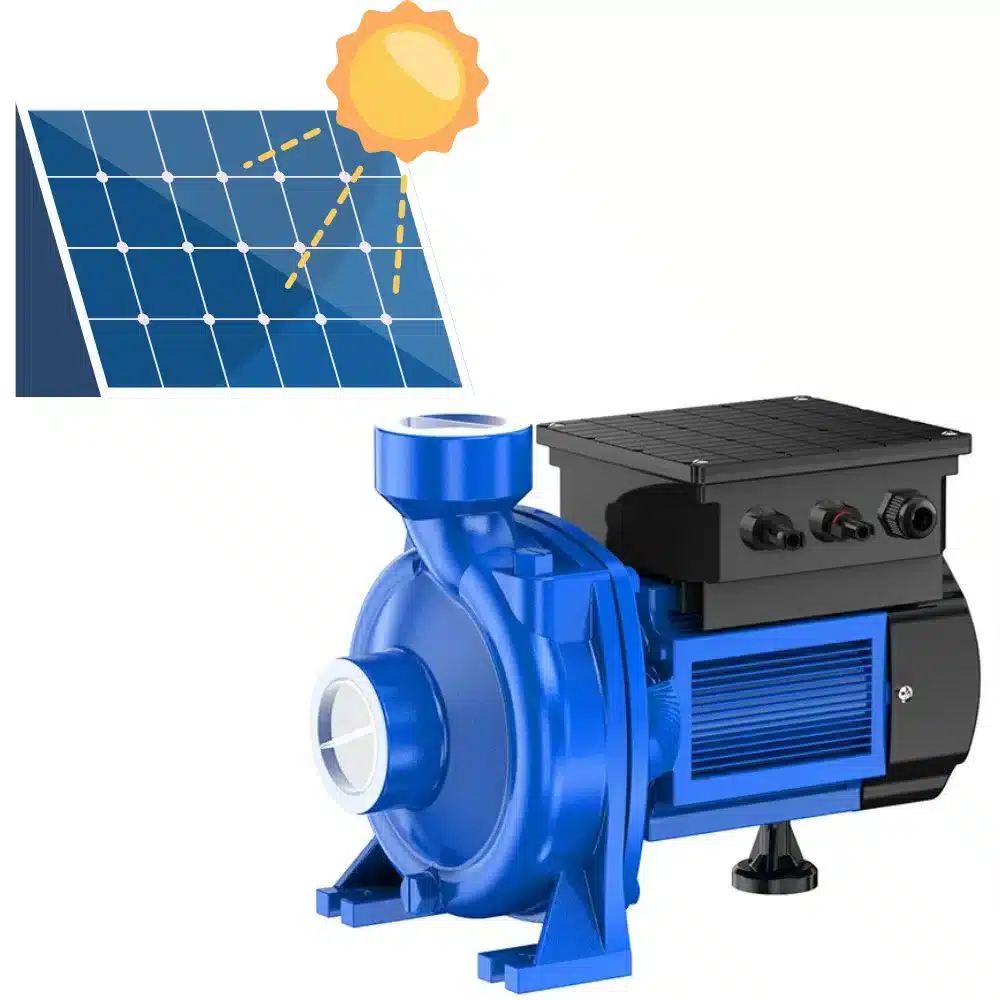
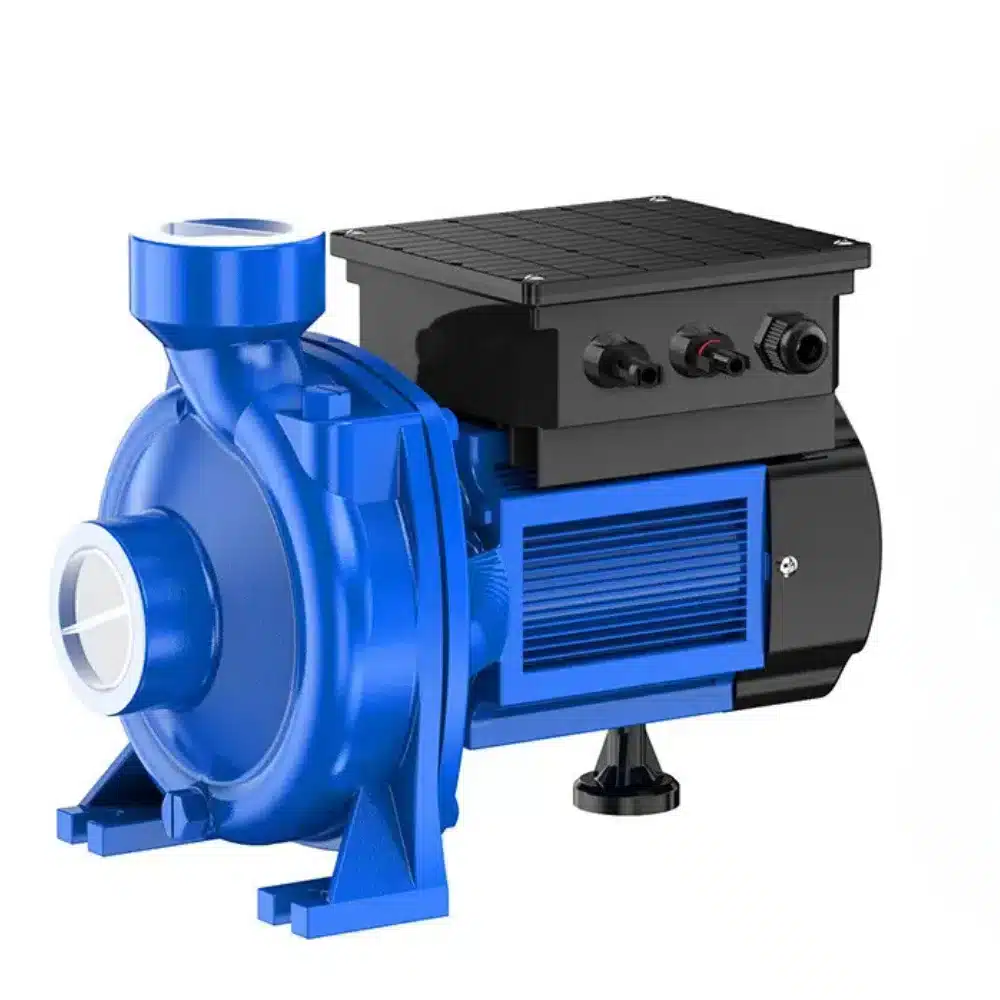
The high-output 96 V solar centrifugal water pump is the top model in the Flocea range: 25,000 litres per hour, brushless permanent-magnet DC motor, built-in MPPT controller, entirely self-sufficient for power. Designed for irrigating large areas, watering big herds and intensive pumping from a surface source (shallow well, hillside reservoir, watercourse, tank), it runs with no mains connection — on sunlight alone.
Recommended solar array: 1,800 W (not included). Total head: 24 m. Maximum suction lift: 8 m.
Full technical specification
| Parameter | Value |
|---|---|
| Maximum flow (Q max) | 25,000 L/h |
| Total head (H max) | 24 m |
| Maximum suction lift | 8 m |
| Supply voltage | 96 V DC |
| Motor power | 1.1 kW / 1.5 hp |
| Recommended array power | 1,800 W |
| Motor type | Brushless permanent-magnet synchronous DC |
| Pump shaft | 304 S/S stainless steel |
| Inlet / outlet size | 2″ × 2″ (DN 50) |
| Electrical protection | IP65 (fully sealed) |
| Temperature range | -15°C to +60°C |
| MPPT controller | Built in |
| Display | Integrated LED status display |
| Dry-running protection | Automatic shutdown + restart after 30 min |
| Warranty | 2 years |
| Solar panel | Not included |
💡 Worth remembering: at 25,000 L/h, this pump fills a 50 m³ pillow tank in two hours in good sunshine — or irrigates several hectares of crops continuously through the day.
What is it designed for?
Large-scale agricultural irrigation
Sprinkler or drip irrigation over 3 to 10 ha. Filling a hillside reservoir or an agricultural pillow tank during the day for night-time irrigation.
Watering large herds
Cattle, sheep and goats — up to 300 head supplied from a well or a reservoir. Complete autonomy even where there is no mains supply.
High-output solar booster set
Supplying a pressurised distribution system (up to 24 m of head). A remote site, a hamlet, a farm building off the mains.
Filling a pool or pond
A 100 m³ pool filled in under four hours of decent sunshine. No electricity consumption on the bill at all.
📍 A real-world example: a market garden irrigates 4 ha of polytunnel tomatoes through the summer. With the 96 V powered by six 300 Wp panels (1,800 W in total), it draws from a hillside reservoir 3 m down and delivers to a drip system 8 m up. Actual flow in full sun: 22,000 L/h. Running cost: €0.
How does this solar pump work?
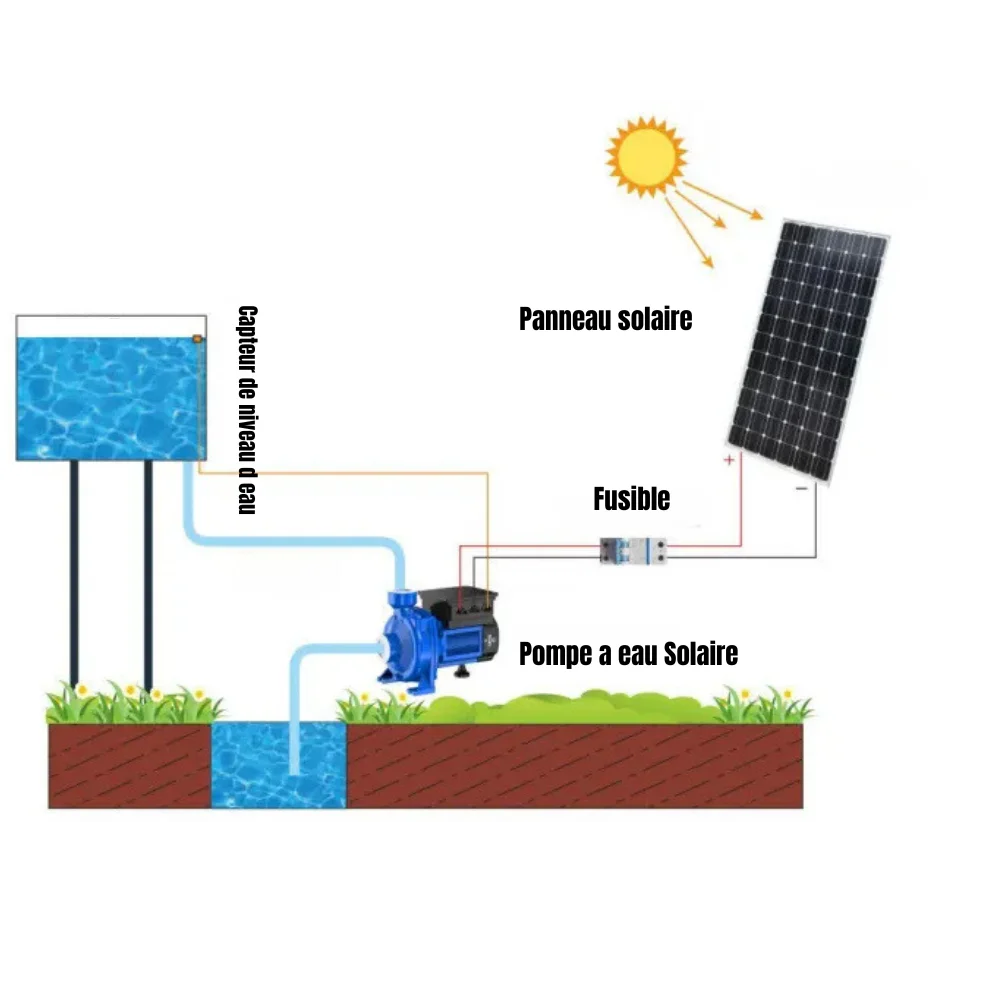
The solar array produces direct current (DC). The built-in MPPT controller adjusts voltage and current in real time to draw the most power from the array — even in partial sun or early and late in the day. That current drives the brushless motor turning the centrifugal impeller directly.
No battery is needed for daytime operation. The water is pumped during the sunny hours and stored in a pillow tank or a reservoir — this hydraulic storage replaces electrical storage and costs far less.
⚠️ Important: this pump is designed for surface sources (suction lift ≤ 8 m). For a borehole deeper than 8 m, a submersible pump is required. If you are unsure about your set-up, contact our technical team — sizing is free of charge.
Installation in 4 steps
The solar surface pump is commissioned with no cable trench and no electrician. Allow half a day for a complete installation.
- Orient and secure the solar array (not included): facing south, tilted 30–35°, with nothing casting shade. Recommended maximum distance between array and pump: 10 m using 6 mm² DC cable.
- Wire up the controller : connect the array’s DC cable to the MPPT box built into the pump. Observe polarity (+ and -).
- Fit the suction hose : DN 50 (2″), length ≤ 15 m, with a foot valve at the end of the pipe down at the source. Never reduce the diameter on the suction side.
- Connect the discharge : DN 50 pipe to the tank or the system. Any reduction in diameter is made on the discharge side only.
💡 First priming: before the very first start, fill the pump body by hand through the filler plug. After that first step, the foot valve lets the pump re-prime itself automatically on every start.
Choosing the right model in the range
If you need less than 25,000 L/h or your head is under 24 m, a less powerful model may be enough and will bring the outlay down:
| Model | Max flow | Max head | Array | Typical use |
|---|---|---|---|---|
| 36 V solar pump | 3,000 L/h | 35 m | 400–600 W | Garden, small well |
| 48 V centrifugal pump | 5,000 L/h | 30 m | 700–800 W | Market gardening, pools |
| 72 V centrifugal pump | 25,000 L/h | 18 m | 900–1,200 W | Irrigation, livestock |
| 96 V centrifugal pump | 25,000 L/h | 24 m | 1,800 W | Intensive agriculture |
What sets the 96 V apart from the 72 V is its greater head (24 m against 18 m): it is the one to choose when the total lift (suction plus delivery) exceeds 18 m, or when the distribution system has significant friction losses. To find out more, see our complete guide to solar water pumps.
Frequently asked questions about the 96 V solar pump
Which solar array should be used with the 96 V pump?
The pump runs at 96 V DC. The panels have to be wired in series to reach that voltage. The recommended total power is 1,800 W minimum — that is, for example, six 300 Wp panels wired in series/parallel. Below that the pump will still run, but at reduced flow. You can go up to 2,200 W without risk to the controller.
Does the pump work in cloudy weather?
Yes, but at reduced flow. Under overcast skies the array produces 15 to 30% of its rated power — the pump idles along at roughly 5,000 to 8,000 L/h. That is why it makes sense to pump into a buffer tank during the day: the stored reserve covers demand even under cloud or after dark.
Can this pump be used on a 15-metre well?
No. This pump is a surface pump : its maximum suction lift is 8 metres. Beyond 8 m deep, only a solar submersible pump will do. Get in touch for sizing tailored to your case.
What area can 25,000 L/h irrigate?
With standard sprinkler irrigation (applying 10 mm/h), this pump covers roughly 2.5 hectares continuously. With drip, coverage can exceed 5 ha depending on the layout. These figures depend on your real head and the pressure your emitters need.
Is the 96 V pump compatible with a battery bank?
Yes. You can run the pump from a 96 V DC battery bank charged by your panels. That allows operation at night or in weak sunlight. The pump accepts any DC voltage between 72 V and 110 V. Our team can help you with sizing the battery bank.
How long does this pump last?
The brushless motor has an estimated life of 10 to 15 years in normal use. The mechanical seals should be checked every three to five years. The foot valve should be replaced if the flow drops. The manufacturer’s warranty is 2 years. The solar array has a life of 25 to 30 years.
Is an electrician needed for the installation?
No. The electrical work is limited to the DC cable between the array and the pump — low-voltage direct current, with no connection to the 230 V mains. No electrical certification is required. The mechanical installation is the same as for any surface pump. Allow half a day.
The 96 V solar centrifugal pump in brief:
- 25,000 L/h — the highest flow in the Flocea range
- 24 m head — suited to installations with a big lift or long pipe runs
- Brushless motor with stainless parts — a 10 to 15 year life, minimal upkeep
- Built-in MPPT — optimal efficiency even in partial sun
- No electricity bill, no mains connection
- Ideal in combination with a Flocea pillow tank for complete water autonomy
Need precise sizing for your project? Contact our technical team — reply within 24 hours, free sizing.