
Booster Sets
A booster set keeps water pressure steady: pump, diaphragm vessel and pressure switch, starting and stopping automatically. From 370 to 750 W, with a 24 or 50 litre vessel, gauge and pressure switch included.
-

370 W booster set – 2,400 L/h, 24 L vessel with pressure gauge and pressure switch
From€249.60 incl. VAT -
550 W booster set – 3,000 L/h, 24 L vessel with pressure gauge and pressure switch
From€315.60 incl. VAT -
750 W booster set – 3,600 L/h, 24 L vessel with pressure gauge and pressure switch
From€368.40 incl. VAT -
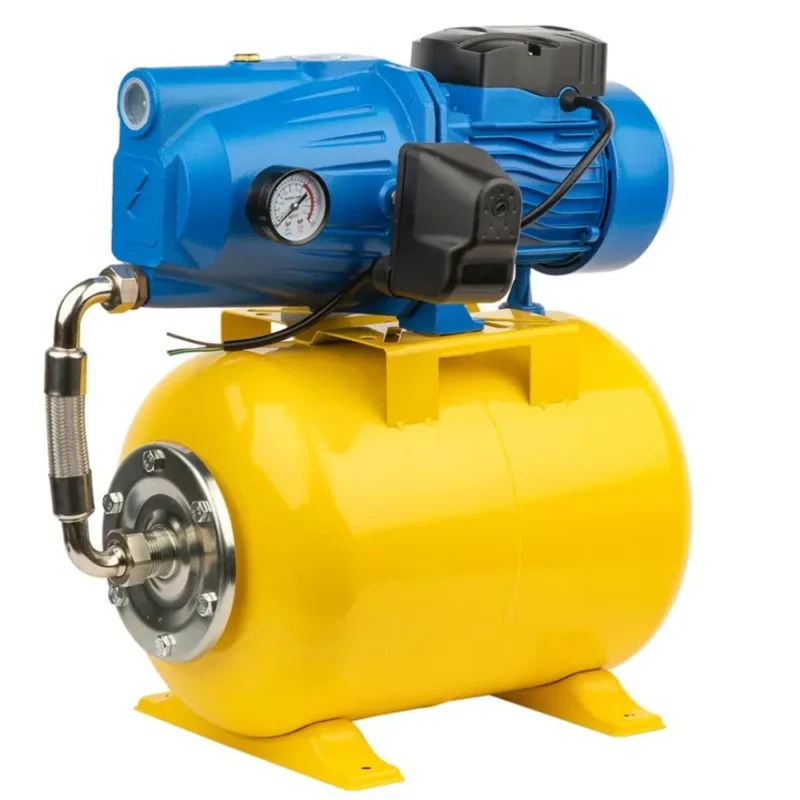
750 W booster set – 3,600 L/h, 50 L vessel with pressure gauge and pressure switch
From€381.60 incl. VAT
Read the full guide
What a booster set does
A booster set keeps water pressure steady in a system. It combines a pump, a diaphragm pressure vessel and a pressure switch: the pump fills the vessel up to the cut-out pressure, stops, then restarts on its own when pressure drops. The vessel stops the motor starting every time a tap is opened, which extends its life.
You fit one when mains pressure is too low, when the water comes from a tank, a well or rainwater harvesting, or when distance and the height to be lifted make pressure collapse at the outlets.
Choosing a model from the range
Three figures narrow it down: the flow rate you need, the pressure to reach and the vessel volume.
| Power | Rated flow | Vessel | Typical use |
|---|---|---|---|
| 370 W (0.5 hp) | 2,400 L/h | 24 L | Irrigation, a single outlet, top-up duty |
| 550 W (0.75 hp) | 3,000 L/h | 24 L | Single dwelling, rainwater tank |
| 750 W (1 hp) | 3,600 L/h | 24 L | Several outlets at the same time |
| 750 W (1 hp) | 3,600 L/h | 50 L | Fewer starts, greater comfort |
Every booster set ships with a gauge and a pressure switch. Flow figures are the manufacturer’s: they are not reached at maximum pressure. Actual flow depends on the head to overcome and on friction losses in your pipework.
A 24 or a 50 litre vessel?
The vessel does not change the flow rate, it changes how often the pump starts. At equal power, a 50 litre vessel lets the pump rest longer between cycles: less wear, less noise, and a steadier pressure at the tap. A 24 litre vessel is enough for occasional use or a single outlet.
Diaphragm pre-charge is checked with the vessel empty, usually 0.2 bar below the switch cut-in pressure. A wrong pre-charge is the most common cause of a booster set that short-cycles.
Booster set, surface pump or self-priming pump?
Three families for three jobs, often combined:
- Booster set: hold constant pressure in a system, starting and stopping automatically.
- Self-priming pump: lift water when the pump sits above the water level, for instance on a well or a buried tank.
- Centrifugal surface pump: transfer high flow at low head, with no pressure control.
Commercial duty and drinking water
For heavy duty — a public building, a farm, a workshop — starts per hour and continuous running time decide the choice, more than rated power. Specify a larger vessel in that case, or a second one in parallel.
For water intended for human consumption, check the wetted-material compatibility on the model’s data sheet, and check the whole chain: potable water pillow tank, filtration and treatment. Electrical work near water follows the local wiring regulations, BS 7671 in the UK.
Frequently asked questions
What is the difference between a booster set and a pump?
A pump moves water. A booster set is the complete assembly — pump, diaphragm vessel and pressure switch — that holds pressure steady and starts on its own.
My booster set short-cycles, what should I check?
Usually the diaphragm pre-charge, measured with the vessel empty, or a punctured diaphragm. Then check the non-return valve seals and the pressure switch settings.
What pressure does a house need?
A domestic system generally runs between 2 and 3.5 bar. Above that you put strain on taps and fittings; below it, comfort drops as soon as two outlets are open.
Can it run off a rainwater tank?
Yes, that is a common use. You need a foot valve with a strainer, a clean suction line, and a rainwater circuit kept strictly separate from the potable one and clearly marked.
Are booster sets noisy?
Noise comes mainly from starts and from vibration passing into the base. A larger vessel spaces out the cycles, and anti-vibration mounts cut the nuisance markedly.
Is dry-run protection needed?
Strongly recommended as soon as the source can empty, tank or well. Running dry destroys the mechanical seal in minutes.