
The capacity of a pillow tank is calculated on the volume you can actually use, not the total volume quoted on the data sheet. The gap between the two is worth knowing before you buy.
- Usable or nominal capacity: don’t confuse them
- Pillow tank capacity: the calculation method
- What capacity to choose for your use
- Fire-water reserve: capacity is set by regulation
- Cost per m³: real value for money by volume
- One large tank or several?
- Installation constraints by capacity
- Frequently asked questions
- Sizing your tank: the essentials
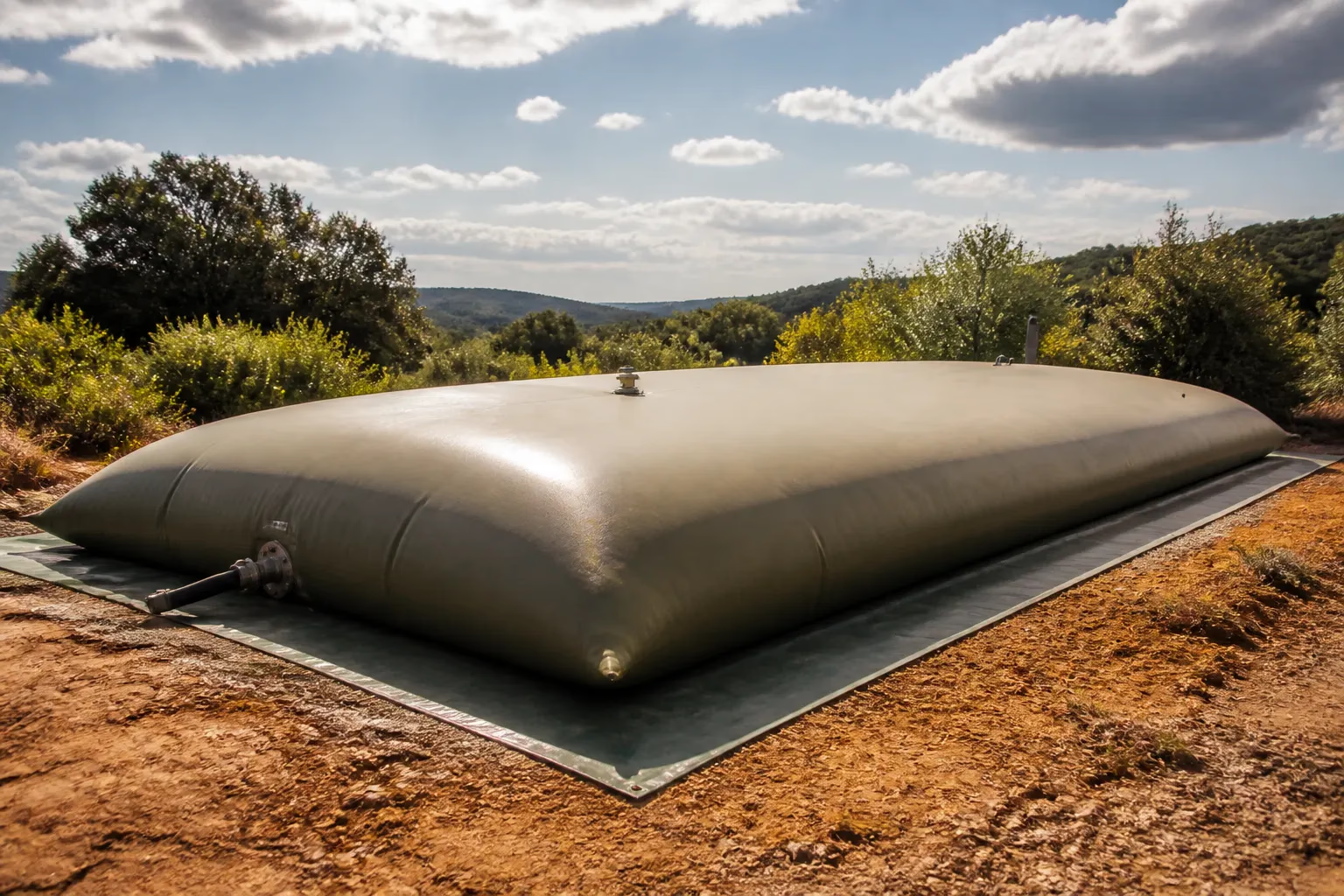
Usable or nominal capacity: don’t confuse them
When a manufacturer advertises a 30 m³ tank, that figure is the total volume: the tank at full charge. The volume you can actually use is always somewhat less.
Two factors eat into the available capacity. First, dead volume: the pump strainer never reaches the lowest point, so a few centimetres of unusable water always remain at the bottom.
In a closed pillow tank, evaporation is virtually nil, unlike an open lagoon. Even so, allow a safety margin of a few percentage points.
In practice: to be sure of 30 m³ usable, choose a nominal capacity of 32 to 33 m³. That margin avoids the classic disappointment of “I thought I had 30 m³”.
Pillow tank capacity: the calculation method
The capacity you need depends on the use. For rainwater harvesting, the basic formula is simple:
Collectable volume (litres) = roof area (m²) × rainfall (mm/year) × 0.8
The 0.8 coefficient covers collection efficiency: some water evaporates, runs past the gutter or is lost in the first flush off the roof. Rainfall varies widely from region to region.
| Region | Average rainfall | Annual collection for 120 m² |
|---|---|---|
| South East and East Anglia | 550 – 700 mm | ≈ 53–67 m³ |
| Midlands | 700 – 850 mm | ≈ 67–82 m³ |
| South West and Wales | 900 – 1,400 mm | ≈ 86–134 m³ |
| Lake District and Scottish Highlands | 1,500 – 3,000 mm | ≈ 144–288 m³ |
Beware the trap: annual collection is not the capacity to install. A tank smooths demand between rainfalls; it does not store a whole year. Size it at 5 to 8% of annual collection — three to four weeks of autonomy.
Estimate your need in seconds.
For agricultural irrigation the reasoning is different: you start from the crop’s needs. Reckon on 3,000 to 5,000 m³ per hectare per season depending on species and climate, and size the tank as a buffer between two supplies.

What capacity to choose for your use
The table below gives realistic orders of magnitude observed in the field. They are starting points: precise sizing takes account of your rainfall and your actual uses.
| Use | Typical capacity | Note |
|---|---|---|
| Vegetable plot / garden watering | 1 à 5 m³ | Enough for seasonal use without a lawn |
| Domestic rainwater harvesting | 5 à 10 m³ | WCs, washing machine, outdoors |
| Livestock watering | 10 à 30 m³ | Depending on herd size and distance to mains |
| Market garden irrigation (≤ 1 ha) | 50 à 150 m³ | Buffer against summer restrictions |
| Arable crop irrigation | 200 à 1,000 m³+ | Winter storage for summer |
| Liquid nitrogen fertilisers | 10 à 50 m³ | Compatible PVC fabric, bunding recommended |
| Fire-water reserve | 30 à 120 m³ | Volume set by the authority — see the dedicated section |
Storing effluents and liquid fertilisers deserves particular care: the high-tenacity PVC fabric must be approved for the liquid stored, and secondary containment is often required depending on the site.
For rainwater harvesting in a crawl space, volume is not the only constraint: the height available beneath the floor also limits what capacity you can install.
- Household: 5 to 10 m³ covers ordinary domestic use
- Market gardener: 50 to 150 m³ per hectare as a buffer against restrictions
- Fire-water reserve: volume imposed by the authority, never freely chosen
Fire-water reserve: capacity is set by regulation
When the tank serves as a fire-water reserve, you no longer choose the volume: the competent authority sets it, based on the site’s risk, the built area and the resources available locally.
In the UK the applicable framework is BS 9990 for fire-fighting water supplies, alongside the LPC Rules / BS EN 12845 where sprinklers are served. Required volumes and flows are determined case by case: confirm them with your Fire and Rescue Service before ordering the tank.
A non-compliant fire-water tank can hold up sign-off of the works. Compliance is checked before purchase, not after delivery.
To be accepted, the reserve must meet the local framework’s requirements: material, flanges, draw-off arrangement, signage and accessibility of the draw-off area. Flocea supplies the tank’s technical documentation for the submission to the authority.
The process is straightforward: you submit the data sheet and compliance documentation to the relevant fire safety service, which approves the design and then inspects the installation at handover. Flocea sizes your reserve free of charge — just get in touch.
Flocea sizes, manufactures and delivers tanks compliant with the framework applicable at your site. Sizing is free of charge.
Cost per m³: real value for money by volume
The cost per m³ stored falls sharply as volume rises. A small tank is expensive per cubic metre; a large one spreads the fixed manufacturing cost.
| Capacity | Indicative price excl. VAT (supply) | Cost per m³ |
|---|---|---|
| 5 m³ | 900 – 1,300 € | ≈ 220 €/m³ |
| 10 m³ | 1,500 – 2,000 € | ≈ 175 €/m³ |
| 30 m³ | 3,500 – 4,500 € | ≈ 130 €/m³ |
| 50 m³ | 5,000 – 6,500 € | ≈ 115 €/m³ |
| 100 m³ | 9,000 – 12,000 € | ≈ 105 €/m³ |
| 200 m³ | 16,000 – 22,000 € | ≈ 95 €/m³ |
These prices are excluding VAT and installation. Fitting typically adds 15 to 30% of the tank price for a simple installation, more where earthworks are substantial.
Doubling capacity does not double the price: going from 5 to 10 m³ adds around 60% in cost for 100% more volume — a strong argument if your needs may grow.
For rainwater harvesting, it pays to reduce consumption first and identify which uses can genuinely be substituted, before sizing the project.
One large tank or several?
Above 100 m³ the question arises: one large tank or several units linked together? A single tank is the cheapest per cubic metre and the quickest to install.
| Criterion | Single tank | Multiple tanks |
|---|---|---|
| Cost per m³ | Lower | Higher (+10 to 20%) |
| Ground | A single flat area | Adapts to slopes |
| Maintenance | Storage 100% out of service | Tanks isolated one by one |
| Scalability | Fixed | Further units can be added |
That modularity suits a growing operation: install 100 m³ now, add another tank next year as the acreage expands.
Installation constraints by capacity
The larger the capacity, the more the installation needs framing. A 5 m³ tank goes down in half a day on a slab or a bed of compacted sand. A large reserve requires a more thorough base and suitable access.
Step 1 — Prepare the base
A level surface clear of stones and roots. On clay soil, a 5 to 10 cm bed of sand spreads the load and protects the fabric.
Step 2 — Lay the geotextile
A certified geotextile beneath the sheet prevents puncturing and abrasion. For drinking water, use a geotextile suitable for contact with water intended for human consumption.
Step 3 — Unroll and connect
The tank is unfolded empty, then connected to the inlets and to the pump, submersible or surface. The first fill is done slowly to let the fabric take shape.
A few rules not to overlook. UV protection is built into the high-tenacity PVC fabric (typical resistance −30 °C to +70 °C). Siting it in a crawl space or in shade extends its life: 15 to 20 years against 10 to 12 in permanent full sun. Also respect distances from buildings and boundaries — particularly for a fire-water tank, whose draw-off area must stay clear and accessible.
Using rainwater for indoor domestic applications is regulated, and the conditions differ from country to country. Likewise, abstraction from a well or borehole may require notification or a licence depending on the volume taken and the intended use. Check the obligations that apply in your area before sizing the project.
Frequently asked questions
What pillow tank capacity should you choose for a house?
For a detached house, a 5 to 10 m³ tank covers watering, washing and supplying the WCs. Below 5 m³ the reserve runs dry quickly in summer.
How do you calculate the tank volume you need?
For rainwater: roof area (m²) × rainfall (mm/year) × 0.8 gives annual collection in litres. The tank is then sized at 5 to 8% of that figure — three to four weeks of autonomy.
What capacity is required for a fire-water reserve?
The volume is not yours to choose: the fire safety authority sets it, based on the site’s risk and the framework applicable in your area. Check with them before ordering — compliance is assessed on the drawings, before installation.
What does a pillow tank cost by capacity?
As a guide, excluding installation: €900 to €1,300 excl. VAT for 5 m³, €1,500 to €2,000 for 10 m³, €3,500 to €4,500 for 30 m³ and €9,000 to €12,000 for 100 m³. Cost per m³ falls sharply with volume. Fitting typically adds 15 to 30% of the tank price.
Is a cheaper imported pillow tank worth it?
For firefighting use, no: without compliance with the applicable framework, the authority will reject the tank and insurance will not cover it. For other uses, a low-grade imported sheet ages badly under UV. A tank with a 5-year warranty and certified material remains the safe long-term choice.
Sizing your tank: the essentials
Getting a pillow tank’s capacity right means thinking in usable volume, calculating your real need rather than copying a neighbour, and factoring in regulation from the outset — especially for a fire-water reserve. The right volume covers your use without paying for empty space or running dry during a restriction.
- Size on usable volume, keeping a margin against the advertised total
- Domestic rainwater: 5 to 10 m³; irrigation: 50 to 300 m³ per hectare
- Fire-water reserve: volume set by the authority, compliance with the local framework mandatory
- Cost per m³ falls with volume; a multi-tank approach keeps you scalable
Precise sizing takes account of your rainfall, your ground and your local constraints. That is exactly what a manufacturer cutting and building to measure can work out with you, quotation and capacity study in hand.
-
Sale!

Pillow tank 25 m³ 25,000 litres – slurry and farm effluent storage
Original price was: 1 119,00€.979,00€Current price is: 979,00€. HT Add to basket -
Sale!
Pillow tank 60 m³ 60,000 litres – static fire-water reserve
Original price was: 2 357,00€.2 239,00€Current price is: 2 239,00€. HT Add to basket -
Sale!
Pillow tank 10 m³ 10,000 litres – rainwater harvesting and storage
Original price was: 630,00€.550,00€Current price is: 550,00€. HT Add to basket -
Sale!

Pillow tank 50 m³ 50,000 litres – agricultural liquid fertiliser storage
Original price was: 1 938,00€.1 809,00€Current price is: 1 809,00€. HT Add to basket