Description
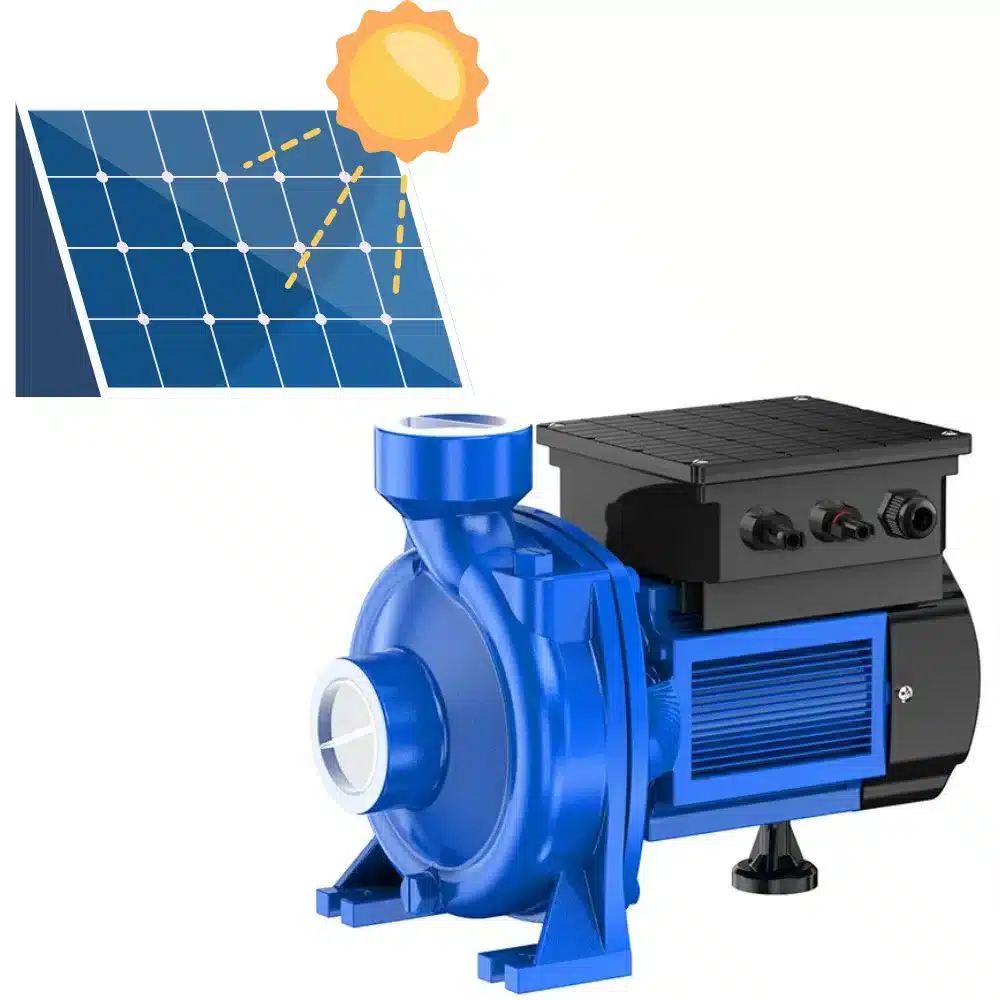
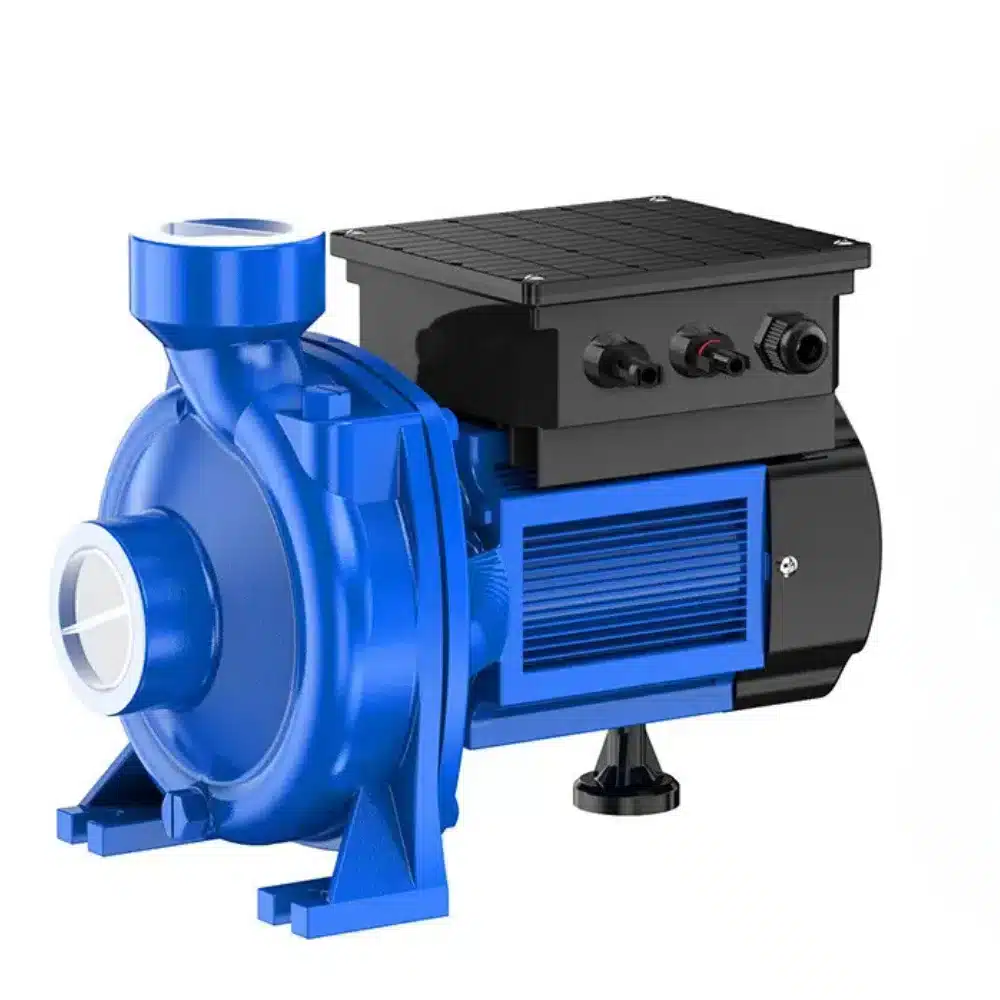
The 48 V solar centrifugal water pump is the mid-range model in the Flocea line-up, designed for installations with a large lift: with a total head of 30 m — the highest of any Flocea solar surface pump — it will push water efficiently even to high or distant draw-off points, at a flow of 5,000 litres per hour. Powered at 48 V DC by a photovoltaic array sold separately, with a brushless motor and built-in MPPT controller. No mains connection at all.
Recommended solar array: 700 W (not included). Total head: 30 m. Maximum suction lift: 8 m.
Full technical specification
| Parameter | Value |
|---|---|
| Maximum flow (Q max) | 5,000 L/h |
| Total head (H max) | 30 m |
| Maximum suction lift | 8 m |
| Supply voltage | 48 V DC |
| Motor power | 0.55 kW / 0.75 hp |
| Recommended array power | 700 W |
| Motor type | Brushless permanent-magnet synchronous DC |
| Pump shaft | 304 S/S stainless steel |
| Inlet / outlet size | 1″ × 1″ (DN 25) |
| Electrical protection | IP65 (fully sealed) |
| Temperature range | -15°C to +60°C |
| MPPT controller | Built in |
| Display | Integrated LED status display |
| Dry-running protection | Automatic shutdown + restart after 30 min |
| Warranty | 2 years |
| Solar panel | Not included |
💡 What this model does best: with 30 m of head, the 48 V pump is the only surface model that can push up to a raised tank, supply a two-storey building from a ground-level source, or make up for a long horizontal pipe run — all without any mains connection.
What is it designed for?
Market gardening and commercial irrigation
Drip or micro-sprinkler irrigation over 0.5 to 2 ha. Filling a pillow tank from a pond or shallow well, lifting up to 30 m.
Supplying an off-grid home
A solar booster set for a home off the mains: WC, washing machine and shower fed from a harvesting tank or a well. The 30 m head covers a two-storey building with a full system.
Filling pools and ponds
Filling a 50 m³ pool in 10 to 12 hours of sunshine. Ideal for pools set high up or far from the water source — the 30 m head absorbs the lift with no appreciable loss of flow.
Watering medium-sized livestock
Feeding troughs for 50 to 120 head (cattle, sheep) from a well or a reservoir. Runs independently where there is no mains supply. Can be paired with a buffer tank for watering at night.
📍 A real-world example: a market garden irrigates 1 ha of vegetables from a pond sitting 2 m below the pump. It feeds a drip system whose highest point is 18 m up. Effective total head: 20 m — comfortably within the 48 V’s capability (30 m max). With two 350 Wp panels (700 W), it has 5,000 L/h in full sun. Running cost: £0.
How does this solar pump work?
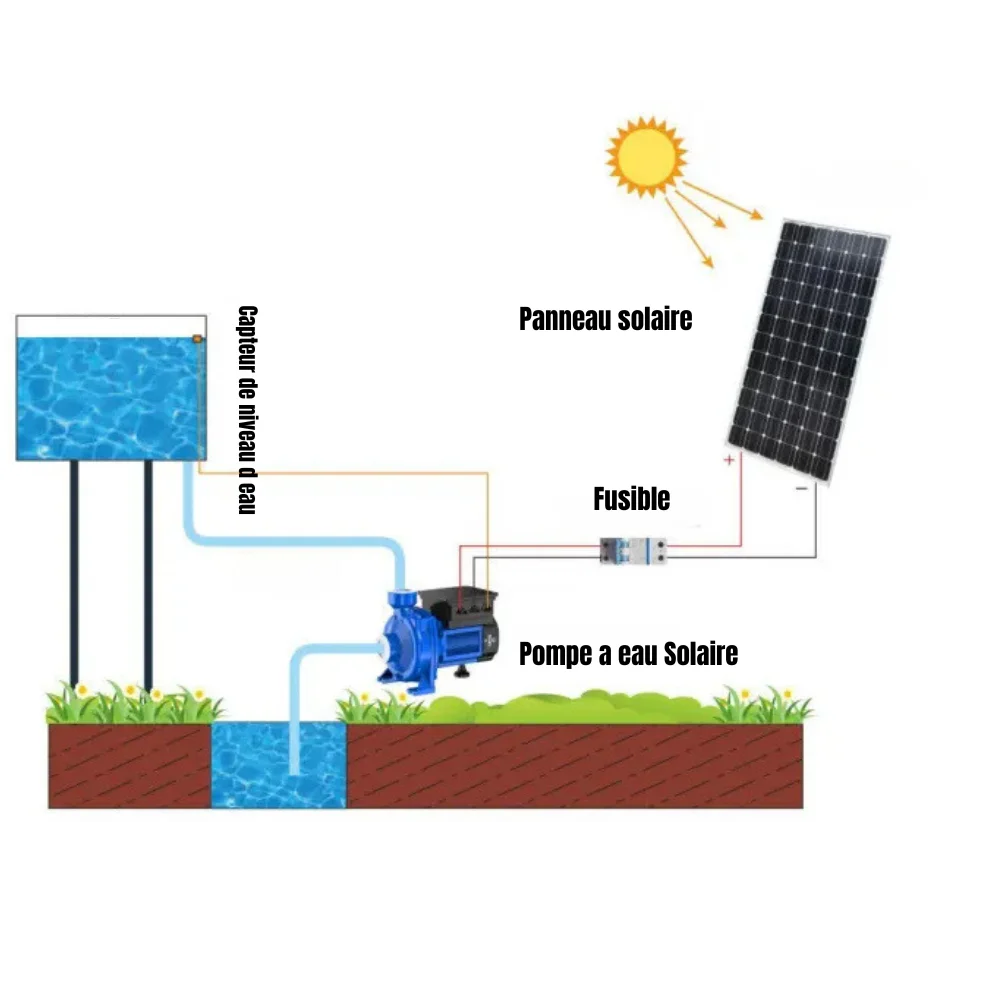
The solar array produces direct current (DC). The built-in MPPT controller optimises voltage and current in real time to draw the most power from the array — including in partial sun or early and late in the day. That current drives the brushless motor turning the centrifugal impeller directly.
No battery is needed for daytime operation. The water is pumped during the sunny hours and stored in a pillow tank — this hydraulic storage is simpler and cheaper than a battery bank.
⚠️ Suction limit: like every surface pump, the 48 V draws water from up to 8 m at most deep. For a well or borehole deeper than 8 m, a solar submersible pump is needed. If in doubt, contact our team — free sizing.
Installation in 4 steps
No electrician and no cable trench required. Allow half a day for a complete installation.
- Orient the solar array (not included): facing south, tilted 30–35°, clear of shade. Recommended power: 700 W (e.g. 2 × 350 Wp panels). Maximum array-to-pump distance: 10 m using 4 mm² DC cable.
- Wire up the MPPT controller : connect the array’s DC cable to the box built into the pump, observing polarity.
- Fit the suction hose : DN 25 (1″), length ≤ 12 m, with a foot valve at the source. Do not reduce the diameter on the suction side.
- Connect the discharge : DN 25 pipe to the tank, the system or the draw-off point. Diameter reductions are made on the discharge side only.
💡 First priming: fill the pump body by hand before the very first start. After that, the foot valve keeps it primed automatically on every subsequent start.
Where this model sits in the range
The 48 V pump sits at the centre of the range: more flow than the 36 V, and more head than any other surface model. It is the natural choice when delivery height is the limiting factor.
| Model | Max flow | Max head | Array | Typical use |
|---|---|---|---|---|
| 36 V solar pump | 3,000 L/h | 35 m | 400–600 W | Garden, small well |
| 48 V centrifugal pump | 5,000 L/h | 30 m | 700 W | Market gardening, off-grid home |
| 72 V centrifugal pump | 25,000 L/h | 18 m | 900–1,200 W | Irrigation, livestock |
| 96 V centrifugal pump | 25,000 L/h | 24 m | 1,800 W | Intensive agriculture |
To understand how to work out your head and choose the right model, see our complete guide to solar water pumps.
Frequently asked questions about the 48 V solar pump
Which solar array should be used with the 48 V pump?
The pump runs in 48 V DC. The panels have to be wired to deliver that voltage. The recommended power is 700 W — that is, for example, two 350 Wp panels wired in series. You can go up to 900 W without risk to the controller. Below 700 W the pump will run, but at reduced flow.
Why choose the 48 V rather than the 36 V or the 72 V?
Can this pump supply a house with water?
Yes, as a solar booster set for an off-grid home. With 5,000 L/h (83 L/min) and 30 m of head it can supply a complete internal system (WC, shower, kitchen, washing machine) from a storage tank. It is worth adding a pressure vessel or a buffer tank to smooth out the variations in flow that come with changing sunlight.
Does the pump work in cloudy weather?
Yes, but at reduced flow. Under overcast skies the array produces 15 to 30% of its rated power, and flow falls to roughly 800–1,500 L/h. The recommended answer is to fill a buffer tank during the sunny hours so there is a reserve to draw on when it clouds over or after dark.
Can it be used on a 10-metre well?
No. The maximum suction lift is 8 metres. For a well of 10 m or more, a solar submersible pump is needed. If your well is exactly 8 m, the pump will be working at the limit of its capability — some safety margin is advisable. Get in touch to have your set-up checked.
How long does this pump last?
The brushless motor has an estimated life of 10 to 15 years in normal use. The mechanical seals should be inspected every three to five years. The foot valve, the main wearing part, should be replaced if you notice the flow dropping (an inexpensive part, £5–15). Manufacturer’s warranty: 2 years.
Is an electrician needed for the installation?
No. The wiring is limited to the low-voltage DC cable between the array and the pump — no connection to the 230 V mains and no electrical certification needed. The mechanical installation is standard: DN 25 suction pipe with a foot valve, discharge to the system or the tank. Allow half a day.
The 48 V solar centrifugal pump in brief:
- 5,000 L/h — a mid-range flow for market gardening, off-grid homes and pools
- 30 m head — the highest in the surface range, for installations with a big lift
- 48 V DC — a 700 W array is enough; simple installation with no electrician
- Brushless motor with stainless parts — 10 to 15 years of life, minimal upkeep
- Built-in MPPT — performance held up even in partial sun
- To pair with a Flocea pillow tank for complete water autonomy
Not sure about the sizing? Contact our technical team — reply within 24 hours, free sizing.