
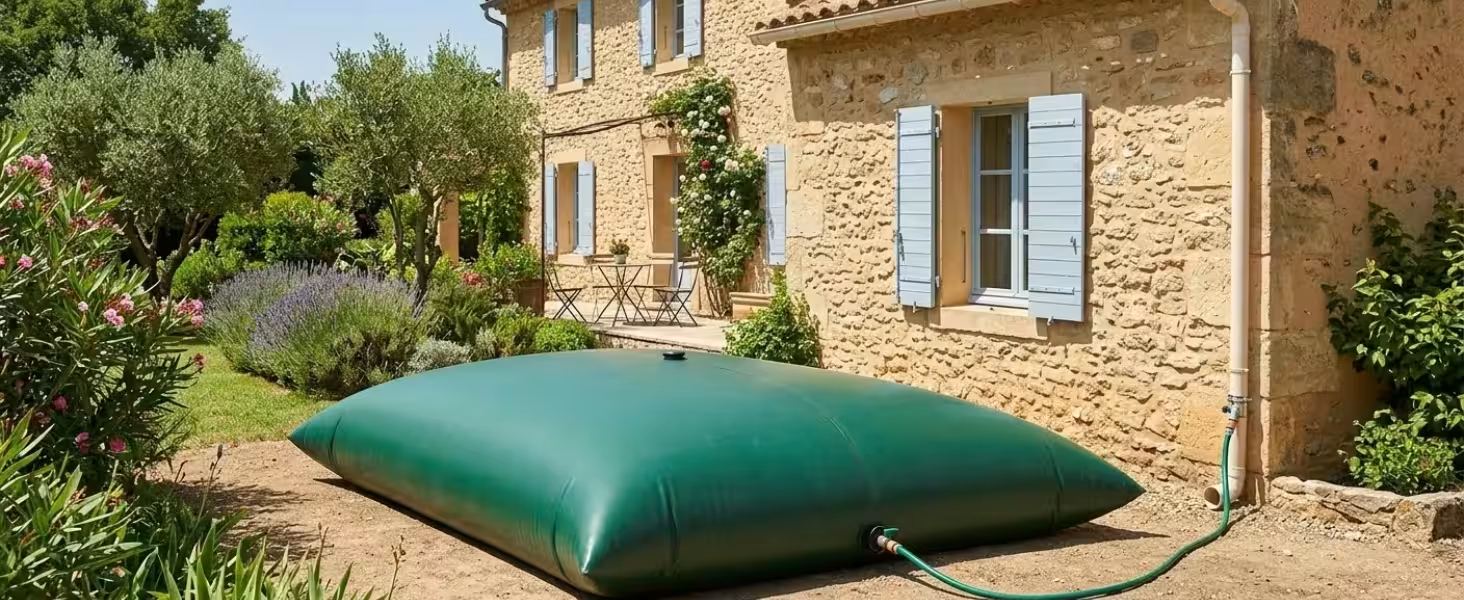
Pillow tanks: the complete guide to choosing the right one for your use
A pillow tank is a collapsible tank made from PVC-coated polyester fabric, designed to store liquids: rainwater, drinking water, liquid fertilisers, hydrocarbons or effluents. Unlike rigid concrete or polyethylene tanks, it sits directly on level ground, folds away when empty and fits into confined spaces such as a crawl space. Available from 1 m³ to over 500 m³, the pillow tank is now the most versatile and cost-effective storage solution for households, farms, local authorities and industry.
Contents
What is a pillow tank?
A pillow tank — also known as a bladder tank or flexible water tank — is a watertight container made from high-tenacity technical fabrics: PVC-coated polyester, or a composite fabric with an inner lining matched to the liquid stored. Fabric thickness generally ranges from 0.9 mm to 1.2 mm depending on the manufacturer and intended use.
The principle is simple: the tank lies flat on prepared ground (geotextile or protective sheet), fills from the top through a fitting, and empties by gravity or with a pump. When empty it folds away for storage — a decisive advantage for seasonal use or sites with little permanent storage space.
What fundamentally sets a pillow tank apart from a rigid tank is its ability to fit confined spaces (crawl space, under a building, sloping ground) and its markedly lower cost at large volumes. For a detailed comparison of the two, see our pillow tank versus rigid tank comparison.
The different uses of a pillow tank
Versatility is the pillow tank’s main strength. Materials and fittings change with the liquid stored and the application, but the principle stays the same. Here are the five main uses.
Rainwater harvesting

This is the most common use. The rainwater pillow tank connects directly to your gutters through a filtering collector. The water collected is used for garden watering, washing vehicles, flushing WCs or supplying the washing machine. Installed outdoors or in a crawl space, it puts an often unused area beneath the house to work.
For a detached house with 100 m² of roof in an area receiving 1,100 mm of rain a year, you can collect around 88 m³ of water annually — 88,000 litres. A 5 to 10 m³ tank stores the equivalent of one to two months of collection, enough to cover watering and outdoor uses. For specific needs, Flocea manufactures bespoke pillow tanks sized to your exact space.
Drinking water storage

Potable water pillow tanks use an inner lining that meets the minimum hygiene requirements of Directive (EU) 2020/2184 for materials in contact with water intended for human consumption. They suit rural areas off the mains, construction sites, temporary accommodation bases and outdoor events.
The water stays shielded from light and direct heat, which limits bacterial growth. Common capacities for drinking water range from 1 m³ (occasional use) to 30 m³ (supplying a hamlet or a long-running site).
Agricultural use: irrigation and fertiliser storage

The agricultural pillow tank answers two main needs: storing water for irrigation (alongside boreholes or mains) and storing liquid fertilisers or farm effluents. Agricultural volumes typically run from 30 to 100 m³, with models resistant to UV and dilute chemicals. Some farms install several tanks in series to reach 200 to 300 m³ in total.
The advantage over a concrete pit or a lagoon: the pillow tank is installed in a few hours with no earthworks, can be moved from one field to another if needed, and in most cases requires neither groundworks nor planning consent.
Fire-water storage
Local authorities and industrial sites must hold water in reserve for firefighting. Flexible fire-water tanks are a quick, cost-effective alternative to buried concrete tanks: they are deployed in days rather than weeks of construction. In the UK the applicable framework is BS 9990 for fire-fighting water supplies, together with the LPC Rules / BS EN 12845 for sprinkler supplies.
Required volumes range from 30 m³ for a small settlement to 120 m³ and above for industrial estates or town centres. Fire-water tanks are supplied with their draw-off equipment (hydrants, stainless steel columns, valves).
Regulations: the size and siting of the reserve must be agreed with the local Fire and Rescue Service and comply with the applicable building regulations. Flocea supports you through that process and supplies the tank’s technical documentation.
Fuel and hydrocarbon storage
Dedicated pillow tanks are available for storing diesel, petrol or other hydrocarbons on temporary sites (construction, forestry, events). They are made from materials that withstand petroleum solvents and must be installed in line with the local regulations covering hazardous substance storage. Standard capacities run from 1 m³ to 10 m³.
How to choose the right capacity
The volume of your pillow tank depends on your use, your daily consumption and, for rainwater, on your roof area and local rainfall. The table below gives a quick steer:
| Use | Recommended capacity | Rule of thumb |
|---|---|---|
| Garden / small vegetable plot | 1 to 5 m³ | ~50 L/day in summer for 1–2 months |
| Rainwater, detached house | 5 to 10 m³ | Roof 80–120 m², area with 900–1,200 mm/year |
| Pool / large garden | 10 to 30 m³ | Pool top-up + intensive watering |
| Drinking water, remote site | 5 to 30 m³ | Depending on number of users and duration |
| Agricultural / irrigation | 30 to 100 m³ | 0.5 to 3 L/m²/day depending on the crop |
| Liquid fertiliser / effluents | 10 to 50 m³ | Depending on seasonal application volume |
| Fire-water storage | 30 to 120 m³ | Agreed with the Fire and Rescue Service by risk |
| Fuel / hydrocarbons | 1 to 10 m³ | Depending on site consumption |
For rainwater, a simple formula estimates your annual collection potential: roof area (m²) × annual rainfall (m) × 0.8 (loss coefficient). Example: 100 m² of roof in an area receiving 1,100 mm/year = 100 × 1.1 × 0.8 = 88 m³ collectable per year.
Where to install a pillow tank
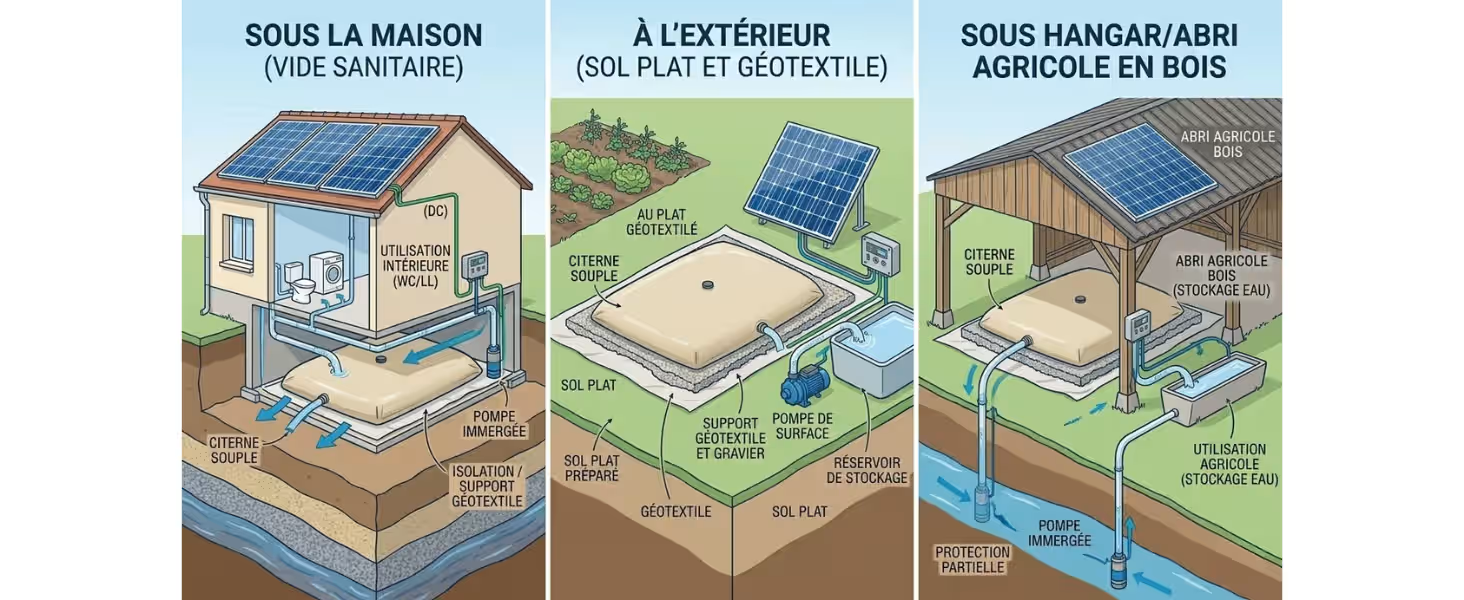
Where you site the tank determines its lifespan and how well it works. There are three main configurations:
In a crawl space (under the house)
This is the most sought-after option for rainwater harvesting in detached houses. The crawl space pillow tank makes use of dead space under the house, sheltered from frost and sun. Installation is straightforward: a protective sheet on the ground, the tank laid flat, one fitting to the gutters and another to your supply network.
Points to check: available height beneath the floor (at least 50 cm when full for small models, 80 cm from 10 m³ upwards), enough access to slide the folded tank in, and ground free of stones or sharp objects. See our crawl space pillow tanks for available dimensions.
Outdoors, on level ground
For large volumes (30 m³ and above), outdoor installation is the norm — as with agricultural tanks, fire-water reserves and industrial storage. The ground must be level, clear of protruding objects and ideally covered with a geotextile or protective sheet. Allow for a slightly raised area so surface water drains away around the tank.
Outdoors, choose a UV-resistant model if the tank stays exposed to the sun for long periods. Flocea tanks are UV-stabilised as standard, but permanent exposure shortens the coating’s life over time. Think about access too: if the tank is to be filled by tanker, allow enough room for the vehicle (3 metres wide as a minimum).
Under a building or canopy
A middle ground between crawl space and open air: siting the tank under a farm building, an open garage or a canopy. This protects it from direct sun and frost while keeping access easy for maintenance and connections. It is a favourite among farmers fitting a liquid fertiliser tank under an existing barn, and among councils placing their fire-water reserve under a covered municipal area.
Quality criteria to check before buying

Not all pillow tanks are equal. Here is what to examine before placing an order:
Fabric thickness and quality. Aim for at least 0.9 mm for domestic use, and 1.1 mm or more for agricultural or industrial use. The fabric should be high-tenacity PVC-coated polyester, not a single-layer PVC that will tear within a few seasons.
UV resistance. If your tank will sit in the sun (outdoor installation), check that UV treatment is explicitly stated. Without it, PVC becomes brittle and cracks within two to three years.
Standards and compliance. For drinking water, insist on materials meeting the minimum hygiene requirements of Directive (EU) 2020/2184. For fire-water storage, sizing should follow BS 9990 and, where sprinklers are supplied, the LPC Rules / BS EN 12845. For fuel, check compliance with the regulations covering oil storage on your site.
Warranty. A quality pillow tank carries at least a 5-year warranty (Flocea’s standard). Be wary of anything under 2 years — it usually signals low-grade fabric.
Fittings and accessories included. Check what comes with the tank: draw-off valve, overflow, suction strainer, filling cap. Some manufacturers charge for these separately.
For everything about day-to-day maintenance and fixing common problems, see our guide how to repair a leaking pillow tank.
Frequently asked questions about pillow tanks
How long does a pillow tank last?
A good-quality pillow tank lasts 15 to 20 years with minimal maintenance. Longevity depends on UV exposure (a tank in a crawl space outlasts one in full sun), the state of the ground beneath it (no stones or sharp objects) and the liquid stored. Flocea tanks carry a 5-year parts and labour warranty.
Can a pillow tank be installed in a crawl space?
Yes — it is one of the most common installations. A crawl space offers protection from frost, sun and weather. Check that the available height is sufficient (50 cm minimum when full), that the ground is clean and level, and that access allows the folded tank to be slid in. The tank then connects directly to the gutters for rainwater harvesting.
Is a pillow tank suitable for drinking water?
Yes, provided you choose a model whose inner lining is suitable for contact with water intended for human consumption, in line with Directive (EU) 2020/2184. The water stays shielded from light and heat, which preserves its quality. Also check that the fittings are made from food-grade materials (stainless steel or brass).
How much does a pillow tank cost?
Price depends on capacity and use. As an order of magnitude: €150 to €400 for a 1 to 5 m³ tank (rainwater), €400 to €1,500 for 5 to 30 m³, and above €1,500 for large agricultural or fire-water capacities (30 to 120 m³). Specialist tanks (drinking water, fuel, fertiliser) cost slightly more because of the certified materials. Request a free quotation for an exact price.
How do you maintain a pillow tank?
Maintenance is simple and infrequent. Empty and rinse the inside once a year (twice if you store drinking water). Visually inspect the fabric, fittings and seams at each emptying. Check that the ground beneath stays clean and free of sharp objects. If you spot a pinhole leak, a repair kit seals it easily without fully draining the tank.
Do you need permission to install a pillow tank?
In the vast majority of cases, no. A pillow tank placed on the ground (not buried) is not treated as a building and needs neither planning permission nor prior notification. Exception: installations storing hazardous products (hydrocarbons) above certain thresholds fall under specific regulations. For fire-water reserves, the installation must be agreed with the Fire and Rescue Service but does not require planning consent.
You now know which type and capacity of pillow tank suits your needs. Flocea manufactures bespoke pillow tanks from 1 m³ to 500 m³ for every use: rainwater, drinking water, agriculture, fire-water, fuel. All our tanks are made in France, comply with the applicable standards and carry a 5-year warranty. Request a free quotation or call us on +33 7 56 81 31 11.